

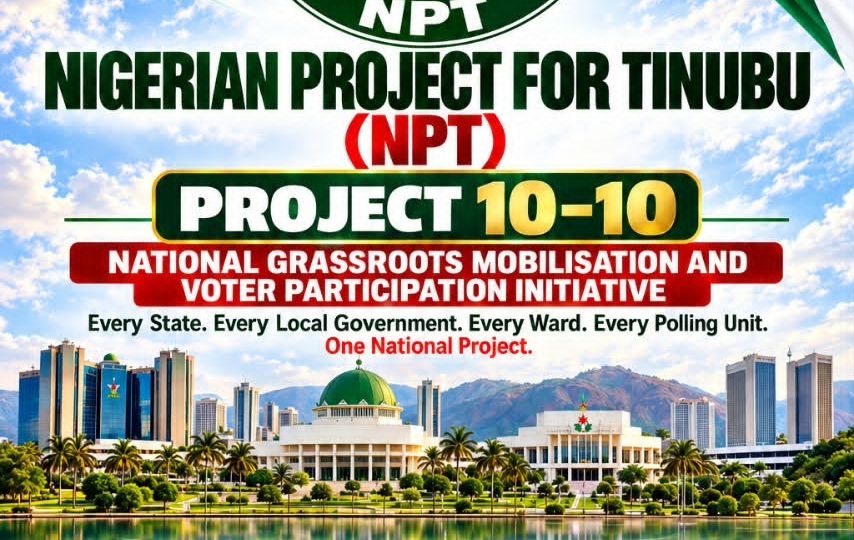
PROJECT 10–10 REBORN: NPT UNVEILS GRASSROOTS STRATEGY TO SECURE TINUBU’S 2027 MANDATE
Bobai: “Our Biggest Priority Is to Unite All Support Groups Behind One National Project for President Tinubu’s Re-election.”
ABUJA — The Nigerian Project for Tinubu (NPT) has announced the resurgence of its grassroots mobilisation initiative, Project 10–10, with a renewed commitment to building a united, coordinated and nationwide support network for President Bola Ahmed Tinubu’s 2027 re-election bid.
At the heart of the initiative is a fundamental priority: to galvanise all existing support bases, political groups, grassroots organisations and independent advocates for President Tinubu into one united national project, where collective efforts are coordinated, strengthened and directed towards a common objective.
The initiative emerged following a closed-door strategic meeting in Abuja led by the National Coordinator of NPT, Barrister Dr. Richard Aboki, who directed the organisation’s leadership to intensify grassroots engagement, strategic communication and nationwide mobilisation ahead of the next presidential election.
Speaking on the renewed vision of Project 10–10, the Director of Strategy, Media and Public Communication, Hon. Victor Mathew Bobai, described the initiative as a deliberate effort to connect national political objectives with the aspirations of ordinary Nigerians while building stronger collaboration among the various groups supporting President Tinubu.
According to Bobai, NPT recognises that numerous organisations, political movements, community networks and independent supporters are already working across Nigeria to advance the President’s re-election bid. He stressed that the greatest opportunity lies in bringing these efforts together through cooperation, coordination and a shared national vision.
“Our biggest priority is to galvanise every support base into one united Nigerian Project for Tinubu. We recognise the contributions of all support groups, political movements, grassroots organisations and individuals working for President Bola Ahmed Tinubu’s re-election.
“Our mission is not to replace existing support groups or diminish their identities. Rather, we want to create an environment where their efforts complement one another, their voices are strengthened, and their collective contributions become more effective.
“When we work separately, our efforts may be limited. When we work together under a common national objective, we can build a stronger, more organised and more impactful movement,” Bobai stated.
He explained that NPT intends to position itself as a coordinating and collaborative platform that encourages synergy among existing support groups while supporting their legitimate activities, strengthening grassroots engagement and promoting responsible political communication.
ONE NIGERIA PROJECT, ONE UNITED SUPPORT BASE
Bobai emphasised that the vision of the Nigerian Project for Tinubu extends beyond establishing another political support organisation.
He explained that the primary objective is to create a united platform where existing groups can collaborate without losing their identities, leadership structures or established areas of operation.
According to him, the success of the initiative will depend on its ability to recognise the work already being done by support groups, identify opportunities for collaboration and develop practical mechanisms for coordinated engagement across the six geopolitical zones.
He said the organisation would encourage constructive partnerships among national, state, local government and ward-level structures, with particular attention to ensuring that grassroots organisations receive recognition and opportunities to contribute to the wider national effort.
“NPT is a project for everyone who believes in the Nigerian Project under President Bola Ahmed Tinubu. We want to bring people together, not create unnecessary divisions. We want to strengthen existing structures, encourage cooperation and ensure that every legitimate contribution adds value to our collective objective,” he added.
Bobai further noted that unity among support groups would enable more effective information sharing, better coordination of community engagement, improved mobilisation planning and a stronger platform for communicating government policies and achievements.
He maintained that the proposed approach would be built on mutual respect, transparency, accountability and a shared commitment to peaceful democratic participation.
PROJECT 10–10 REBORN: TAKING THE MESSAGE TO THE GRASSROOTS
The renewed Project 10–10 initiative will provide an operational framework for translating NPT’s national vision into practical grassroots engagement.
Under the proposed structure, activities will extend from the national leadership through state coordinators, Local Government Areas, wards and polling-unit communities.
The programme will focus on establishing functional local structures, coordinating volunteers, conducting community outreach, providing voter education and communicating verified information about government policies and programmes.
Bobai explained that the grassroots strategy would complement the broader objective of uniting support groups by creating opportunities for participating organisations to coordinate their activities, share information and support community engagement initiatives.
He stressed that the project would not be judged merely by the number of structures established or announcements made, but by the effectiveness of its coordination, the quality of its community engagement and the measurable results of its activities.
“The Renewed Hope Agenda must reach every ward, every community and every polling unit. But beyond reaching the grassroots, we must also unite the people and organisations already working towards the same objective.
“Project 10–10 will therefore combine grassroots engagement with a broader coordination strategy that encourages support groups to work together, communicate responsibly and contribute meaningfully to the democratic process,” he said.
SECURITY, GOVERNANCE AND RENEWED HOPE
Bobai also highlighted the Federal Government’s security efforts, stressing the importance of sustained collaboration between the armed forces, security agencies, state governments and local communities.
He referenced the leadership of the Minister of Defence, General Christopher Gwabin Musa, in the broader national security effort, noting that Nigerians expected continued progress against terrorism, banditry, kidnapping and other threats to public safety.
While acknowledging that insecurity remained a significant national concern, he argued that addressing the challenge required operational improvements, stronger intelligence coordination, community cooperation and sustained support for security personnel.
According to him, NPT would encourage its participating groups to communicate verified developments in security and governance while listening to the concerns of citizens whose communities continued to face challenges.
He added that responsible political communication must acknowledge genuine public concerns and promote constructive engagement, factual information and accountability.
Bobai maintained that the Nigerian Project could only be strengthened through credible communication, respect for differing opinions and a commitment to addressing the issues affecting citizens.
UBA SANI’S KADUNA: A STRATEGIC CENTRE OF MOBILISATION
The NPT director also commended Kaduna State Governor, Senator Uba Sani, for his administration’s governance and development initiatives, describing Kaduna as strategically important to the broader political engagement ahead of 2027.
Bobai expressed confidence that the Governor’s grassroots relationships and development agenda would contribute to the mobilisation environment in Kaduna State.
He also welcomed the planned commencement of the APC presidential campaign in Kaduna, describing the state as an important starting point for nationwide political engagement.
The APC Presidential Campaign Council has announced Kaduna as the venue for the presidential campaign flag-off on October 24, 2026, while its inaugural meeting is scheduled for October 14 at the State House Banquet Hall in Abuja.
Bobai described the planned flag-off as an opportunity to demonstrate organisational readiness, encourage cooperation among support groups and build momentum for the national campaign.
He acknowledged Senator Abdulaziz Yari’s leadership of the campaign council and expressed confidence that effective coordination across the geopolitical zones would strengthen the party’s engagement with Nigerians.
He added that Kaduna’s role should extend beyond hosting a campaign event to encouraging collaboration among political stakeholders and support organisations committed to peaceful democratic participation.
WHY NPT WANTS ALL SUPPORT GROUPS UNDER ONE COLLABORATIVE UMBRELLA
According to Bobai, the existence of numerous support groups demonstrates the level of interest and commitment among Nigerians who support President Tinubu. However, he argued that greater cooperation could improve the effectiveness of their individual contributions.
He identified the following as key priorities for NPT:
- Coordination without domination: Encourage collaboration among support groups without undermining their existing leadership, identity or independence.
- Shared national objectives: Develop a common framework through which participating organisations can contribute to the broader Nigerian Project.
- Stronger grassroots engagement: Support outreach activities across states, LGAs, wards and communities.
- Strategic communication: Encourage the sharing of verified information, coordinated public education and responsible responses to political developments.
- Recognition of participating groups: Ensure that existing organisations and their members are recognised for their contributions to the collective effort.
- Capacity development: Promote training, leadership development, volunteer coordination and improved organisational management.
- Accountability and measurable outcomes: Encourage participating groups to document activities, assess progress and maintain transparent reporting mechanisms.
Bobai stressed that the proposed framework should be understood as a platform for cooperation rather than an attempt to create unnecessary rivalry among organisations that share similar objectives.
He explained that NPT’s strength would depend on its willingness to listen to other groups, build partnerships and demonstrate practical value to the wider support community.
“Our message is simple: nobody needs to lose their identity to become part of a bigger national project. Every group has its own contribution, leadership and constituency. What we need is a framework that allows us to combine our strengths and work towards a common objective,” he said.
VOLUNTARY PARTICIPATION, CITIZEN WELFARE AND RESPONSIBLE ENGAGEMENT
Bobai also emphasised that grassroots mobilisation must recognise the contributions of volunteers and the socioeconomic realities facing many Nigerian communities.
He explained that NPT intended to explore transparent and lawful support programmes for volunteers and community engagement activities, alongside initiatives that recognise citizens’ contributions to peaceful democratic participation.
He maintained that participation must remain voluntary and that assistance or incentives should never be conditional on how an individual votes or on their political choice.
According to him, the Nigerian Project should promote dignity, responsible participation and opportunities for citizens to contribute to national development.
He added that NPT would encourage its participating organisations to operate transparently, respect democratic institutions and uphold the principles of peaceful political engagement.
A RESPONSE TO OPPOSITION NARRATIVES THROUGH FACTS AND ENGAGEMENT
Addressing the increasingly competitive political environment ahead of 2027, Bobai said NPT intended to encourage evidence-based communication and direct engagement with citizens.
He argued that political criticism should be addressed through verifiable information, clear explanations of government policies and an honest presentation of the administration’s record.
He said the organisation would encourage participating supporters to correct demonstrably false claims responsibly while acknowledging legitimate public concerns.
“We believe that the best response to criticism is credible information, visible engagement and demonstrable results. We must communicate responsibly, respect the right of Nigerians to ask questions and allow citizens to assess the available evidence for themselves,” Bobai stated.
He added that the organisation would promote discipline, peaceful political engagement and respect for democratic institutions throughout its activities.
“A GOOD TERM DESERVES ANOTHER TERM”
Bobai said the political philosophy behind the initiative was that an administration seeking another mandate must communicate its record, explain its policies and remain engaged with the people.
For NPT, the proposed message, “A Good Term Deserves Another Term,” represents its commitment to presenting the case for President Tinubu’s re-election through organised communication, public engagement and grassroots mobilisation.
He explained that NPT would work towards a coordinated national presence while encouraging cooperation among existing support groups and developing responsible grassroots communication structures.
The organisation’s ambition, he said, was to provide a platform through which Nigerians who voluntarily support the President could participate in organised community engagement and lawful electoral mobilisation.
He maintained that the ultimate decision must remain with the Nigerian electorate through a free, peaceful and lawful democratic process.
THE ABOKI DIRECTIVE: FROM STRATEGY TO NATIONAL COLLABORATION
The closed-door meeting in Abuja marked a renewed organisational focus for the Nigerian Project for Tinubu.
Under the leadership of National Coordinator Barrister Dr. Richard Aboki, NPT intends to develop Project 10–10 into a structured platform for grassroots engagement, strategic communication and collaboration among support groups.
With Hon. Victor Mathew Bobai directing strategy, media and public communication, the organisation will seek to align its messaging, field activities and reporting procedures with its national objectives.
The proposed programme will focus on expanding organisational coverage, training volunteers, documenting community engagement and strengthening communication between the national leadership and participating grassroots structures.
Beyond these activities, NPT intends to prioritise the establishment of practical channels for cooperation among support groups across Nigeria’s six geopolitical zones.
The objective is to build a collaborative environment in which organisations can share experience, coordinate appropriate activities and contribute their respective strengths to a common national purpose.
For NPT, the challenge ahead is to translate its national ambition into credible, measurable and sustained grassroots participation while building confidence among the organisations it seeks to bring together.
CONCLUSION: UNITED EFFORT, STRONGER IMPACT
As political preparations intensify ahead of 2027, the Nigerian Project for Tinubu says its mission is to strengthen the collective efforts of Nigerians and organisations supporting President Bola Ahmed Tinubu’s re-election.
The organisation believes that a united, cooperative and well-coordinated support base can contribute more effectively than fragmented efforts operating without sufficient communication or collaboration.
Its vision is to encourage existing groups to work together, strengthen grassroots participation, improve public communication and create a more organised platform for peaceful democratic engagement.
NPT’s biggest priority is clear: to galvanise all support bases into one united project, ensuring that collective efforts become stronger and that all support groups working for President Bola Ahmed Tinubu’s re-election bid receive a platform for cooperation, recognition and meaningful participation.
Project 10–10 Reborn is therefore being positioned not simply as a grassroots mobilisation initiative, but as part of a broader effort to unite, coordinate and strengthen the contribution of support groups to the 2027 democratic process.
The message from Abuja is clear: One Nation. Six Zones. One Progressive Future. One United Nigerian Project for Tinubu.
